Publications
Journal articles, conference papers, preprints and theses, grouped by year. You can also find my work on Google Scholar and arXiv.
Selected research highlights
On Composite Quantum Hypothesis Testing
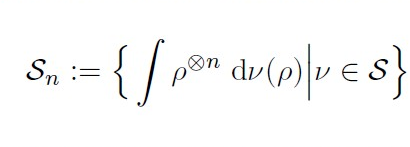
We extend quantum Stein's lemma in asymmetric quantum hypothesis testing to composite null and alternative hypotheses. As our main result, we show that the asymptotic error exponent for testing convex combinations of quantum states against convex combinations of quantum states can be written as a regularized quantum relative entropy formula. We prove that in general such a regularization is needed but also discuss various settings where our formula as well as extensions thereof become single-letter.
Communications in Mathematical Physics 385, 55–77 (2021)
Quantum Sequential Hypothesis Testing
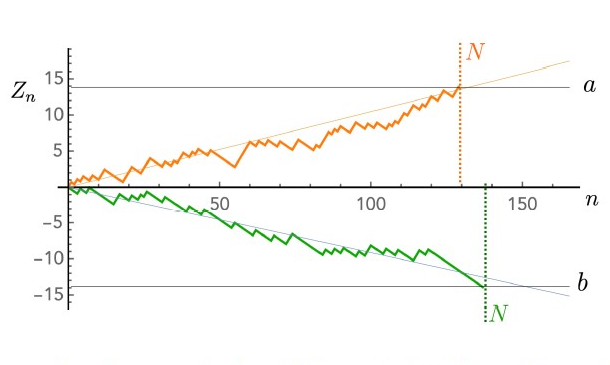
We introduce sequential analysis in quantum information processing, by focusing on the fundamental task of quantum hypothesis testing. Our goal is to discriminate between two arbitrary quantum states with a prescribed error threshold, ϵ, when copies of the states can be required on demand. We obtain ultimate lower bounds on the average number of copies needed to accomplish the task. We give a block-sampling strategy that allows to achieve the lower bound for some classes of states. The bound is optimal in both the symmetric as well as the asymmetric setting in the sense that it requires the least mean number of copies out of all other procedures.
Physical Review Letters 126, 180502 (2021)
Amortized channel divergence for asymptotic quantum channel discrimination
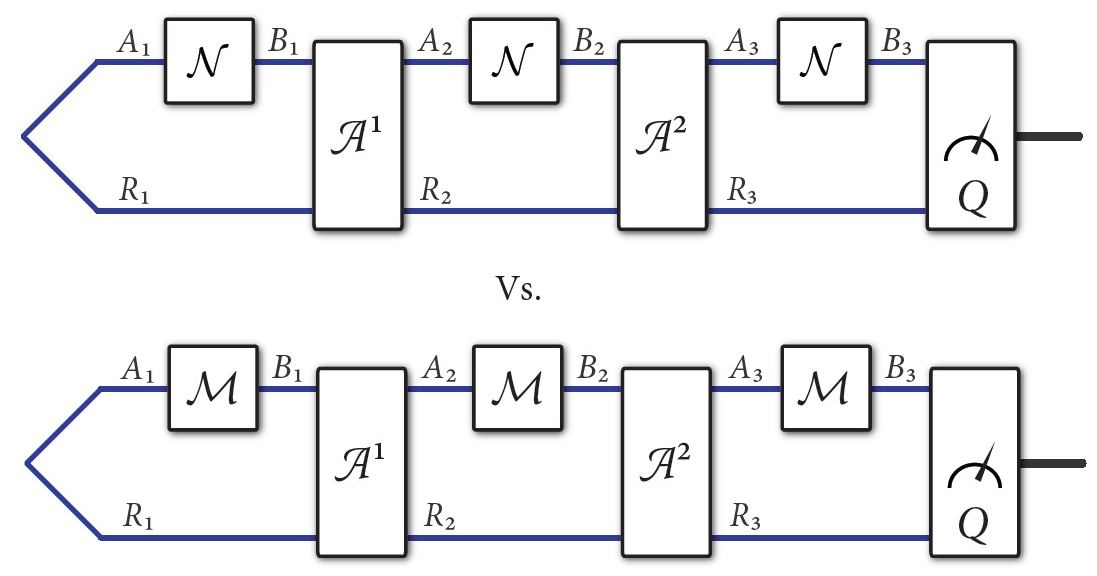
First, we establish the strong Stein's lemma for classical-quantum channels by showing that asymptotically the exponential error rate for classical-quantum channel discrimination is not improved by adaptive strategies. Second, we recover many other classes of channels for which adaptive strategies do not lead to an asymptotic advantage. Third, we give various converse bounds on the power of adaptive protocols for general asymptotic quantum channel discrimination.
Letters in Mathematical Physics 110, 2277–2336 (2020)
Convexity and Operational Interpretation of the Quantum Information Bottleneck Function
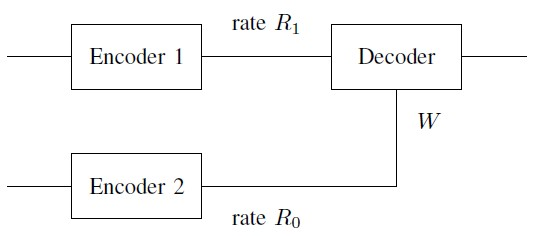
In classical information theory, the information bottleneck method (IBM) can be regarded as a method of lossy data compression which focusses on preserving meaningful (or relevant) information. As such it has recently gained a lot of attention, primarily for its applications in machine learning and neural networks. We prove the convexity of the quantum IB function, and then giving an alternative operational interpretation of it as the optimal rate of a bona fide information-theoretic task,
IEEE International Symposium on Information Theory (ISIT), 1157–1161 (2019)
Bounds on Information Combining With Quantum Side Information
Bounds on information combining are entropic inequalities that determine how the information (entropy) of a set of random variables can change when these are combined in certain prescribed ways. Such bounds play an important role in classical information theory, particularly in coding and Shannon theory; entropy power inequalities are special instances of them. The arguably most elementary kind of information combining is the addition of two binary random variables (a CNOT gate), and the resulting quantities play an important role in Belief propagation and Polar coding. We investigate this problem in the setting where quantum side information is available.
IEEE Transactions on Information Theory 64, 4739–4757 (2018)
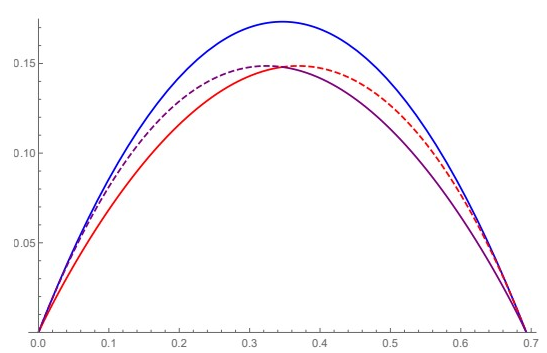
Efficient Quantum Pseudorandomness with Nearly Time-Independent Hamiltonian Dynamics
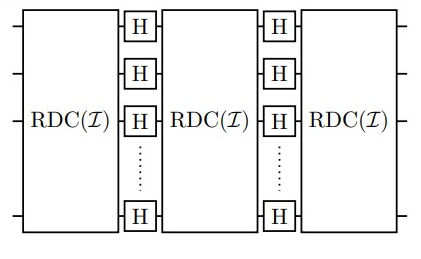
We provide new constructions of unitary t-designs for general t on one qudit and N qubits, and propose a design Hamiltonian, a random Hamiltonian of which dynamics always forms a unitary design after a threshold time, as a basic framework to investigate randomising time evolution in quantum many-body systems. The new constructions are based on recently proposed schemes of repeating random unitaires diagonal in mutually unbiased bases.
Physical Review X 7, 021006 (2017)
No matching publications. Try fewer words or clear the filters.
2026
-
Quantum estimation, channel orders, and private capacity
PreprintarXiv preprint (2026)
-
The exact strong converse exponent for private communication over quantum channels
PreprintarXiv preprint (2026)
-
Stochastic neural networks for quantum devices
Journal articleQuantum Machine Intelligence 8, 98 (2026)
-
Conditional contraction coefficients and their applications to quantum networks
PreprintarXiv preprint (2026)
-
Quantum Doeblin Coefficients: Interpretations and Applications
Journal articleQuantum 10, 2115 (2026)
-
On the complexity of quantum states and circuits from the orthogonal and symplectic groups
Journal articleJournal of Physics A: Mathematical and Theoretical 59, 205302 (2026)
-
Information Contraction under (ε, δ)-Differentially Private Mechanisms
PreprintarXiv preprint (2026)
2025
-
Non-Linear Strong Data-Processing for Quantum Hockey-Stick Divergences
PreprintarXiv preprint (2025)
-
Optimization driven quantum circuit reduction
Journal articleNew Journal of Physics 27, 104509 (2025)
-
Rényi Partial Orders for BISO Channels
Conference paperGeometric Science of Information (GSI 2025), LNCS 16033, 112–120 (2025)
-
Neural Guided Sampling for Quantum Circuit Optimization
PreprintarXiv preprint (2025)
-
Distributed Quantum Hypothesis Testing Under Zero-Rate Communication Constraints
Journal articleAnnales Henri Poincaré (2025)
-
On Strong Converse Bounds for the Private and Quantum Capacities of Anti-degradable Channels
PreprintarXiv preprint (2025)
-
Sharp estimates of quantum covering problems via a novel trace inequality
PreprintarXiv preprint (2025)
-
Layer Cake Representations for Quantum Divergences
PreprintarXiv preprint (2025)
-
Partial Orders and Contraction for BISO Channels
Conference paperIEEE International Symposium on Information Theory (ISIT), 1–6 (2025)
-
Distributed Quantum Hypothesis Testing Against Product States Under Zero-Rate Communication Constraints
Conference paperIEEE International Symposium on Information Theory (ISIT), 1–6 (2025)
-
Some properties and applications of the new quantum f-divergences
PreprintarXiv preprint (2025)
2024
-
Quantum normalizing flows for anomaly detection
Journal articlePhysical Review A 110, 022443 (2024)
-
Quantum Rényi and f-Divergences from Integral Representations
Journal articleCommunications in Mathematical Physics 405, 208 (2024)
-
Sample Complexity of Locally Differentially Private Quantum Hypothesis Testing
Conference paperIEEE International Symposium on Information Theory (ISIT), 2921–2926 (2024)
-
Quantum Doeblin Coefficients: A Simple Upper Bound on Contraction Coefficients
Conference paperIEEE International Symposium on Information Theory (ISIT), 557–562 (2024)
2023
-
Quantum Differential Privacy: An Information Theory Perspective
Journal articleIEEE Transactions on Information Theory 69, 5771–5787 (2023)
-
Quantum Network Discrimination
Journal articleQuantum 7, 1064 (2023)
-
Ultimate Limits for Quickest Quantum Change-Point Detection
Journal articlePhysical Review Letters 131, 020602 (2023)
-
Chain Rules for Rényi Information Combining
Conference paperIEEE International Symposium on Information Theory (ISIT), 204–209 (2023)
-
Bounding Quantum Capacities via Partial Orders and Complementarity
Journal articleIEEE Transactions on Information Theory 69, 283–297 (2023)
2022
-
On contraction coefficients, partial orders and approximation of capacities for quantum channels
Journal articleQuantum 6, 862 (2022)
-
Sequential Quantum Channel Discrimination
Conference paperIEEE International Symposium on Information Theory (ISIT), 270–275 (2022)
2021
-
On Composite Quantum Hypothesis Testing
Journal articleCommunications in Mathematical Physics 385, 55–77 (2021)
-
Quantum Sequential Hypothesis Testing
Journal articlePhysical Review Letters 126, 180502 (2021)
-
Discrimination and estimation of incoherent sources under misalignment
Journal articlePhysical Review A 103, 022406 (2021)
2020
-
Amortized channel divergence for asymptotic quantum channel discrimination
Journal articleLetters in Mathematical Physics 110, 2277–2336 (2020)
-
Rényi Bounds on Information Combining
Conference paperIEEE International Symposium on Information Theory (ISIT), 2297–2302 (2020)
-
An Alphabet-Size Bound for the Information Bottleneck Function
Conference paperIEEE International Symposium on Information Theory (ISIT), 2383–2388 (2020)
2019
-
Stein’s Lemma for Classical-Quantum Channels
Conference paperIEEE International Symposium on Information Theory (ISIT), 2564–2568 (2019)
-
Convexity and Operational Interpretation of the Quantum Information Bottleneck Function
Conference paperIEEE International Symposium on Information Theory (ISIT), 1157–1161 (2019)
2018
-
From asymptotic hypothesis testing to entropy inequalities
PhD thesisPhD thesis (2018)
-
Bounds on Information Combining With Quantum Side Information
Journal articleIEEE Transactions on Information Theory 64, 4739–4757 (2018)
2017
-
From Log-Determinant Inequalities to Gaussian Entanglement via Recoverability Theory
Journal articleIEEE Transactions on Information Theory 63, 7553–7568 (2017)
-
Decoupling with random diagonal unitaries
Journal articleQuantum 1, 18 (2017)
-
Unitary 2-designs from random X- and Z-diagonal unitaries
Journal articleJournal of Mathematical Physics 58, 052203 (2017)
-
Discrimination Power of a Quantum Detector
Journal articlePhysical Review Letters 118, 160502 (2017)
-
Efficient Quantum Pseudorandomness with Nearly Time-Independent Hamiltonian Dynamics
Journal articlePhysical Review X 7, 021006 (2017)
-
Convolutional Polar Codes
PreprintarXiv preprint (2017)
2016
-
Schur Complement Inequalities for Covariance Matrices and Monogamy of Quantum Correlations
Journal articlePhysical Review Letters 117, 220502 (2016)
-
Operational meaning of quantum measures of recovery
Journal articlePhysical Review A 94, 022310 (2016)
-
Polar Codes in Network Quantum Information Theory
Journal articleIEEE Transactions on Information Theory 62, 915–924 (2016)
2015
-
An improved rate region for the classical-quantum broadcast channel
Conference paperIEEE International Symposium on Information Theory (ISIT), 2782–2786 (2015)
-
Polar codes in quantum information theory
Master’s thesisMaster’s thesis (2015)
2014
-
Efficient achievability for quantum protocols using decoupling theorems
Conference paperIEEE International Symposium on Information Theory (ISIT), 536–540 (2014)